Microsoft OneNote: Save Notes
- 4.6
- Rating
- 1.00B
- Installs
- Free
- Price
 Analysis by App-foxy
I tend to judge a note-taking app by what happens on a busy day, not by how attractive its blank page looks. When a thought arrives during a meeting, a receipt needs saving, or I suddenly remember an errand while cooking, the useful tool is the one that lets me capture it without creating another problem later. Microsoft OneNote: Save Notes fits that role well because it can become a central place for written notes, clipped material, lists, sketches, and reference pages rather than just another stream of disconnected reminders.
After using it as a productivity app, my impression is that its real value comes from giving information a shape. A quick note can remain quick, but it can also grow into a structured notebook with sections and pages. That makes it suitable for students, office workers, families, researchers, and anyone whose ideas do not arrive in a neat order. It is free, aimed at Everyone, and developed by Microsoft Corporation, so it is easy to recommend as a low-risk starting point for building a more dependable personal system.
Turning scattered thoughts into a workable system
I find that the hardest part of keeping useful notes is not capturing them; it is making sure they remain understandable once the day gets busy. This section looks at how a few simple choices—where a note belongs, what to call it, and when to review it—can turn scattered thoughts into a system I can actually rely on. It also sets up the practical routines that make that structure worthwhile.
You May Also Like

 AccuWeather: Weather Radar
AccuWeather Review: A Quick, Clear Forecast for Everyday Decisions
For everyday plans, the best forecast is the one you can understand quickly. AccuWeather makes rain timing, radar, and local conditions easy to act on, with a few trade-offs.

 Hill Climb Racing
Why Hill Climb Racing Still Turns Crashes Into One More Run
A tiny car, a bumpy hill and one more upgrade: Hill Climb Racing keeps resurfacing because its simple chaos makes every near-miss feel personal.

 AliExpress - Shopping App
AliExpress Makes Global Shopping Feel Personal, but Shoppers Bear the Risk
AliExpress turns a global marketplace into a pocket-sized discovery engine. Its reach is useful, its shopping loop compelling, and its trade-offs easy to miss.

 Lords Mobile: Kingdom Wars
Lords Mobile Is a Kingdom-Building Routine, Not a Quick Match
A case-by-case verdict on the building, battles, device demands, and social commitments that make Lords Mobile rewarding for some players and exhausting for others.

 PDF Scanner app - TapScanner
TapScanner Makes Paperwork Easier to Capture, Check, and Share
TapScanner makes scanning with a phone feel less like a rescue operation and more like a dependable step in getting work done. Its capture tools are useful, though not flawless.

 Block Blast!
 Shows How Much a Puzzle Game Can Leave Out
A quiet grid game shows why puzzle players increasingly value instant clarity, repeatable skill and low-pressure play—and where the genre still needs to catch up.
More From Our News Desk
View All News


Start with the problem before opening the app
The best way to use OneNote is not to begin by creating dozens of notebooks. I first ask what keeps getting lost. If the problem is unfinished tasks, I create a simple planning area. If it is reference material, I make a notebook for information I expect to revisit. If it is meeting notes, I give those notes a predictable home. This small decision matters because the app can hold almost anything, and unlimited flexibility can become clutter when there is no rule behind it.
I like treating the app as the middle layer between capture and action. A note is not automatically useful just because it was saved. My workflow is to record the thought quickly, place it somewhere recognizable, and later decide whether it should become a task, a reference page, or something to delete. That separation keeps the capture moment fast without allowing every temporary thought to become permanent digital furniture.
A practical setup can be modest: one notebook for personal life, one for work or study, and a few sections inside each. I would avoid making a separate notebook for every project unless the project genuinely needs its own boundaries. Pages are easier to maintain when their names describe an outcome or topic rather than a vague date. “Questions for the landlord” is more useful later than “Tuesday notes.”
This approach also answers an important question: is OneNote a task manager? I would not use it as my only task manager if I need strict due-date handling, recurring reminders, or a highly focused list of next actions. It can support planning, but its strength is the flexible context around a task. I might keep the project background, decisions, links, and checklist together in OneNote while using a dedicated task tool for deadlines that must not slip.
Capture quickly without losing the thread
The app works best when I allow notes to be rough at first. During a conversation, I can write fragments instead of trying to produce polished prose. Later, I can turn those fragments into headings, a checklist, or a clearer summary. That is a better use of attention than interrupting a discussion to format every sentence perfectly.
One useful habit is to create a temporary “inbox” page for unprocessed material. I use it for ideas, copied details, questions, and reminders that do not yet have a permanent location. At the end of a work session, I scan that page and move meaningful items into their proper sections. The important trade-off is that an inbox only works if it is emptied regularly; otherwise, it becomes a second junk drawer.
For longer work, I prefer one page per meeting, lesson, or research session rather than one enormous running document. That makes the page easier to revisit and gives me a natural place for a short conclusion at the bottom. I can record what was decided, what remains unclear, and what needs action. Those three lines often save more time later than the original notes.
OneNote is also comfortable with mixed material. A page can contain prose, lists, headings, and visual references in the same workspace. That is valuable when a project involves both explanation and evidence. For example, while planning a room renovation, I might keep measurements, color ideas, a shopping checklist, and questions for a contractor together. A plain text editor would be faster for a paragraph, but less useful for that combination.
Organization that supports retrieval
The notebook, section, and page structure is the feature I rely on most. I think of notebooks as broad areas, sections as projects or themes, and pages as individual working documents. Subpages can help when a main page needs supporting material, although I try not to build a hierarchy so deep that I forget where I put something.
Naming is more important than elaborate structure. I use a consistent pattern for recurring notes, such as the topic followed by the date, and I put the decision or status near the top. When I return weeks later, I can understand the page without rereading every line. This is a small discipline, but it turns the app from storage into a usable archive.
Search is especially helpful when I remember a phrase but not the notebook where I saved it. Still, I would not depend on search as an excuse for careless filing. Search can find a word; it cannot always tell me which copy is current or why the note mattered. I mark important pages with clear titles and keep a short “current status” line near the beginning of active projects.
Another non-obvious advantage is that the flexible page canvas suits notes that change shape over time. A planning page can begin as a list of questions, gain meeting notes, and finish as a decision record. I do not have to migrate the material into a new format after every stage. The weakness is the same flexibility: if I place text wherever it happens to fit, the page can become visually confusing. A little structure at the start prevents a lot of cleanup later.
A repeatable routine is more valuable than a perfect template
My preferred routine has three passes. The first is capture, where speed matters and rough wording is acceptable. The second is clarification, where I rewrite ambiguous fragments and separate facts from actions. The third is review, where I check active pages and decide what still deserves attention. The app supports all three, but it cannot perform the judgment for me.
For a daily review, I would look at the inbox page, current project pages, and any list that affects tomorrow. I add a short next step to projects that have stalled. “Work on presentation” is too broad; “choose the three examples for slide two” gives me a starting point. OneNote is particularly good at holding the reasoning behind that next step, which is something many minimalist task lists leave out.
For weekly planning, I make a page that records commitments, open questions, and items waiting on other people. I then link the review back to the detailed project pages through clear page names or internal references where appropriate. This creates a useful map without duplicating every detail. I also archive completed material instead of deleting it immediately, because old decisions can explain why a current plan looks the way it does.
A realistic example is a parent managing a school event. During the week, they might capture a teacher’s request, a list of supplies, volunteer names, and a rough schedule. On one page, those pieces can be separated into headings for decisions, shopping, contacts, and follow-up. Before the event, the page becomes a checklist. Afterward, it can hold lessons for the next event. That continuity is more useful than scattering each piece across messages, paper scraps, and separate list apps.
Students can use the same pattern for a course: one section for each subject, a page for each lecture, and a review page that turns notes into questions. I would not simply copy every sentence from class. I would leave space for definitions, examples, and questions I still cannot answer. The app is then supporting learning rather than acting as a passive transcript.
Where the experience can become frustrating
The biggest weakness is that a flexible workspace demands maintenance. A person who wants to open an app and see only three precisely prioritized tasks may find OneNote too open-ended. It can store a plan beautifully, but the user still has to decide what deserves attention today. For strict productivity systems, a dedicated task manager may be a better front door, with OneNote serving as the project notebook behind it.
Large notebooks can also become intimidating. When every old idea remains visible, the active material competes with the archive. I reduce that friction by creating an archive section and moving finished projects out of the daily view. I also avoid keeping multiple versions of the same plan. One clearly labeled current page is easier to trust than several pages with similar names.
Formatting freedom has a cost as well. A page can look organized on the day it is created and messy after several edits. I try to use a small set of conventions: one title, short headings, checklists for actions, and a final status line. I do not spend time decorating notes unless the visual treatment helps me understand the material.
There is also a difference between collecting information and retrieving it under pressure. If I save a long article or a dense meeting record without a summary, I may technically have the information but still waste time finding the useful part. My solution is to add a short “why this matters” note whenever I save something important. That extra sentence often has more practical value than the saved material itself.
People who mostly write quick shopping lists may find the app heavier than necessary. A simple notes app can be faster for a handful of short reminders. Likewise, users who need advanced database views, highly automated workflows, or a strict calendar-centered system may prefer a more specialized tool. OneNote earns its place when notes need context, structure, and room to develop.
What the current app represents
OneNote has been available since February 7, 2012, and the current version is 16.0.19127.20320. Its long presence helps explain why it feels more like a mature digital notebook than a fashionable single-purpose capture tool. The app has accumulated a broad audience: it has passed 500 million installs, with an average rating of 4.6 from around 1.5 million ratings. Those figures do not guarantee that it will match every workflow, but they do suggest that the basic notebook model works for many kinds of users.
I also appreciate that the price is free. That makes experimentation easier: I can test a notebook structure without committing money before I know whether the habit will last. The free entry point does not remove the need to think about organization, but it lowers the barrier for a student, a family, or someone replacing paper notes gradually.
The Everyone age rating also fits the app’s general purpose. It is a productivity workspace rather than a game or entertainment service, and its usefulness depends mainly on how the user chooses to structure information. The developer, Microsoft Corporation, gives it a familiar place in the Microsoft ecosystem, which may be convenient for people already using Microsoft tools, though I would still choose it based on workflow rather than brand alone.
Who should adopt it—and who should skip it
I would recommend OneNote to someone whose notes regularly mix words, lists, reference material, and ongoing project context. It is especially strong for meeting records, study notes, household planning, travel research, creative development, and personal knowledge that needs to remain available beyond the day it was captured.
I would also suggest it to people who have tried several tiny note apps and keep losing the surrounding context. The answer is not always another faster inbox. Sometimes the missing piece is a place where a note can grow into a page with a clear purpose. OneNote provides that room without forcing every thought into a rigid template.
I would be more cautious with users who want zero maintenance. If your ideal system shows only the next action, hides everything else, and automatically pushes overdue work into view, a focused task manager will probably feel better. I would also steer heavy database users toward a tool designed around tables and structured records. OneNote can imitate many layouts, but imitation is not always the same as efficiency.
For someone deciding whether to install it, my advice is to run a small trial rather than build an elaborate system immediately. Create one notebook, one inbox page, one active project section, and one archive. Use it for a week with real notes. If you can retrieve yesterday’s information quickly and finish the review routine without resentment, expand gradually. If the open canvas makes you hesitate every time you capture something, choose a simpler app instead.
My recommendation after using it as a daily notebook
What I like most is the way OneNote connects the fleeting moment with the larger project. A thought can start as two words, become a checklist, and eventually turn into a useful record of what happened. That progression is its strongest contribution to a sustainable productivity system. It helps me keep context close to action instead of forcing me to reconstruct the story from scattered apps.
What I like least is the responsibility that comes with that freedom. The app will not rescue a neglected inbox or decide which of five similarly named pages is authoritative. I have to create simple rules, review them, and archive aggressively enough to keep the active workspace calm.
Overall, I see Microsoft OneNote: Save Notes as a strong free choice for people who want a durable, flexible notebook rather than a bare list of reminders. I would recommend starting small, using consistent page names, adding a short summary to important material, and pairing it with a dedicated task tool when deadlines are central. Used that way, it becomes less a place where I dump information and more a dependable home for the thinking that supports everyday work.
FAQs for Microsoft OneNote: Save Notes
01What platforms is Microsoft OneNote available on?
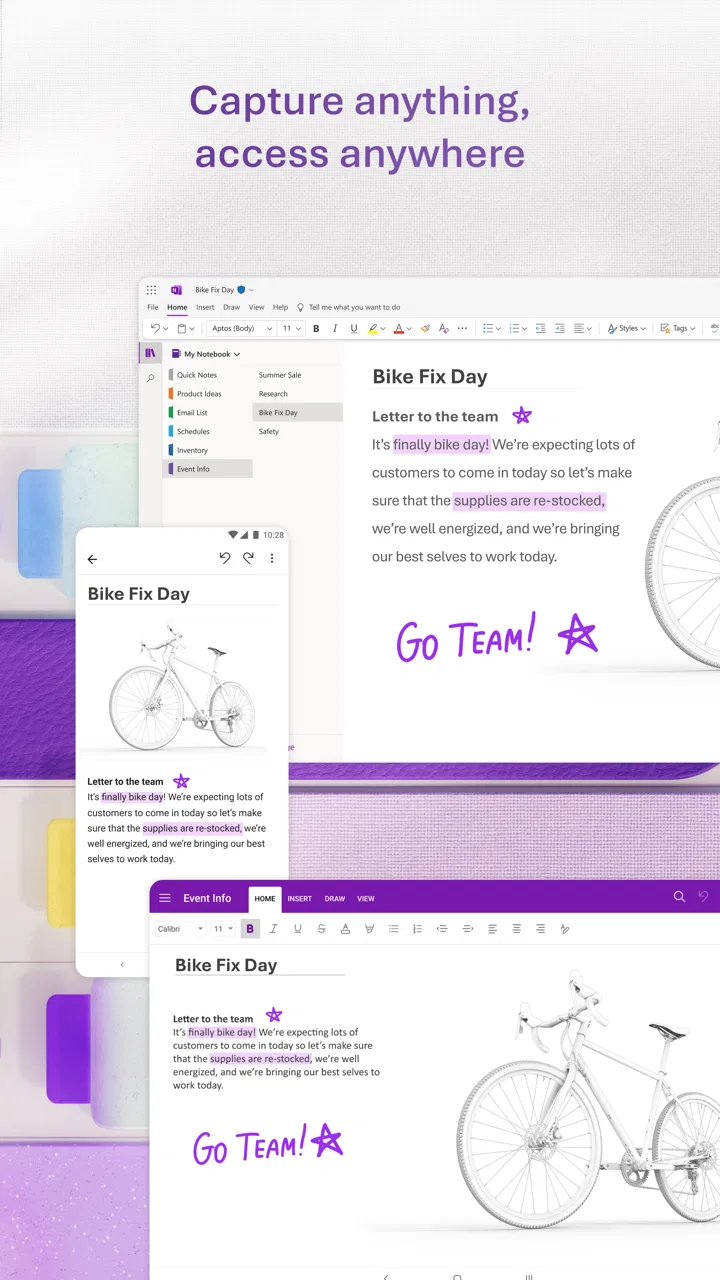
Microsoft OneNote is available on multiple platforms, including Windows, macOS, Android, and iOS. This cross-platform availability ensures that your notes are synchronized across all your devices, allowing for seamless access and editing whether you're on your desktop, smartphone, or tablet.
02Is Microsoft OneNote free to use?
Yes, Microsoft OneNote is free to download and use across all platforms. However, certain advanced features might require a Microsoft 365 subscription. The free version provides ample functionality for most users, including note-taking, organization, and basic formatting options.
03Can I use OneNote offline?
Yes, OneNote can be used offline, allowing you to create and edit notes without an internet connection. All changes made offline will automatically sync to your cloud account once you reconnect to the internet, ensuring your data is always up to date across all devices.
04How secure is my data in Microsoft OneNote?
Microsoft OneNote offers robust security features, including password protection for individual sections and industry-standard encryption for data stored in the cloud. Microsoft also complies with various global privacy standards, ensuring that your notes and personal information are kept secure and private.
05Can I collaborate with others in OneNote?
Yes, OneNote supports collaboration, allowing you to share notebooks with others. Multiple users can edit and view notes simultaneously, making it a great tool for teamwork and project management. Changes are updated in real-time, providing a seamless collaborative experience.
Pros
- Seamlessly syncs across all devices.
- Offers versatile note-taking options.
- Supports multimedia and attachments.
- Allows collaborative editing with ease.
- Organizes notes efficiently with tags.
Cons
- Requires a Microsoft account to use.
- Can be overwhelming with too many features.
- Offline access is limited without setup.
- Interface may feel cluttered to some users.
- Search function can be slow with large data.

Microsoft OneNote: Save Notes
Gallery